Nature Photography for Beginners: Capture Better Outdoor Moments
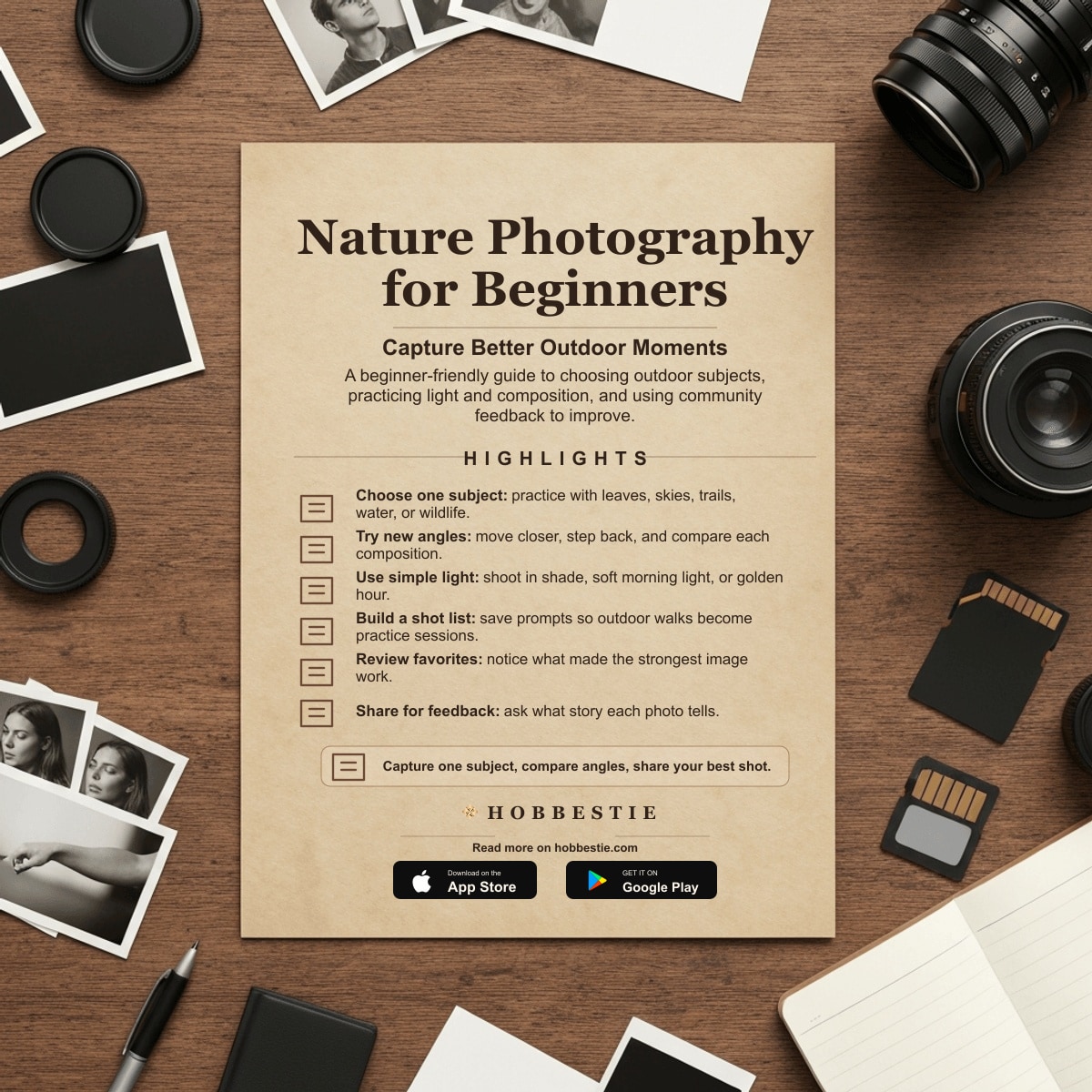
A nature photography for beginners guide should make the hobby feel clear before it asks you to buy anything or become an expert. The best first step is small: take five photos of the same subject from different angles. That gives you a real starting point, a reason to notice details, and a way to decide whether the hobby fits your energy. Hobbestie is built for this kind of beginner moment because it pairs practical digital resources with community support, so you can learn in public without feeling lost.
Why Nature Photography Works as a Beginner Hobby
Start with curiosity, not perfection
Most people make a new hobby harder than it needs to be. They start by comparing themselves with experts, collecting too many supplies, or trying to understand every term before they have one simple win. Nature Photography works better when you treat the first week as an observation period. You are learning what catches your attention, what questions repeat, and what kind of rhythm feels enjoyable enough to return to.
Longer daylight and outdoor routines make summer a natural time to practice. That seasonal energy matters because a hobby becomes easier when it attaches to something you already do. You can connect the practice to a walk, a weekend errand, a quiet evening, or a short learning session. The goal is not to create a perfect routine immediately. The goal is to gather enough positive evidence that you want to keep going.
Give your hobby one simple theme
Beginners often get stuck because the category feels too wide. A theme narrows your attention. Your first theme might be based on color, material, place, style, era, technique, or the story behind an object or result. You can change the theme later, but having one for the first week helps you make decisions quickly.
Use a beginner filter: can you explain your theme in one sentence? If the answer is yes, you can build a small routine around it. If the answer is no, make it narrower. A clear theme also makes community participation easier because you can ask better questions and share progress that other people can respond to.
Build a Seven-Day Starter Routine
Use tiny repeatable actions
Your first routine should be easy enough to complete on a normal day. Try this rhythm: day one, choose your theme. Day two, save one beginner guide or template. Day three, complete one short practice session. Day four, document what you noticed. Day five, ask one question in a community. Day six, repeat the easiest action. Day seven, decide what you want to keep, change, or ignore.
For nature photography, a useful weekly loop is to choose one composition rule, shoot ten examples, and save your favorite three. This turns the hobby from a vague interest into something measurable without making it feel like homework. You are not trying to master the whole subject. You are learning how to return.
Track what you notice
Documentation is a beginner's best friend. Keep notes on what you tried, what confused you, what felt satisfying, and what you want to research next. A simple digital tracker can save photos, links, dates, questions, and tiny lessons learned. Over time, those notes become your personal map.
Good tracking also prevents the all-at-once trap. Instead of collecting random ideas across your phone, browser tabs, and memory, keep one home base. That home base can be a Hobbestie resource, a spreadsheet, a notes app, a printable worksheet, or a community post thread. What matters is that you can find your next step quickly.
Use Digital Resources Without Overcollecting
Choose resources that make action easier
Digital resources should reduce friction, not become a second hobby. Start with one or two supports such as a shot list, lighting checklist, editing notes, feedback rubric, location idea list. A template helps you organize what you are learning. A short lesson gives you sequence. A checklist lowers the chance that you forget the basics. A community prompt gives you a reason to share before you feel fully ready.
Avoid saving twenty resources before you practice. The better order is learn, try, record, ask, and repeat. Once you know what part of the hobby you actually enjoy, you can add more specific resources with confidence.
Let community replace guesswork
The fastest way to feel less alone is to ask a focused beginner question. Try: "Which photo tells the clearest story without extra explanation?" A question like that invites stories, examples, and practical advice. It also helps you see how other beginners think through the same uncertainty.
On Hobbestie, community matters because hobbies are not only about information. They are about belonging, momentum, and shared language. When you see someone else's imperfect start, your own first attempt feels less intimidating. That is often the difference between watching a hobby from the outside and actually joining it.
Turn Practice Into Something Useful
Save your beginner process
As you learn, pay attention to the steps you wish someone had explained sooner. Those notes can become useful to the next beginner. You might create a beginner shot list or seasonal photo challenge calendar, a short resource list, a mini tutorial, or a simple checklist. You do not need to monetize anything right away. First, make your process clear enough that another person could follow it.
This is where a hobby can become part of a larger creative life. Your early questions, mistakes, and examples are valuable because they are recent. Experts sometimes forget what beginners need. A beginner who documents honestly can create resources that feel friendly and practical.
Keep the first offer small
If you eventually want to share or sell a digital resource, keep the first version narrow. Help someone complete one task, understand one concept, or start one routine. A focused resource is easier to finish and easier for another beginner to trust.
Hobbestie supports that path by connecting hobbies, communities, online courses, templates, and digital products in one place. You can begin as a learner, participate as a community member, and later package what you know into something helpful.
Your Next Step
Start nature photography with one theme, one tiny practice session, one digital resource, and one community question. Give yourself seven days before judging the result. If the routine gives you curiosity, calm, connection, or confidence, keep building.
Ready to begin? Join Hobbestie to find beginner-friendly communities, online courses, templates, downloadable guides, and digital resources that help your next hobby become easier to start and easier to sustain.